From Evince
Published 2026-07-29
If you’ve been researching ways to improve your home’s water quality, you’ve likely encountered two common options: salt-free water filtration systems and salt-based water softeners.
Many homeowners immediately ask the same question:
“I don’t want salt in my water.”
It’s a reasonable concern, but it’s also one of the biggest misconceptions about water treatment.
The truth is that salt-free systems and salt-based softeners solve different problems. Understanding how each works can help you choose the right solution for your home, your water quality, and your lifestyle.
This is probably the most common myth about water softeners.
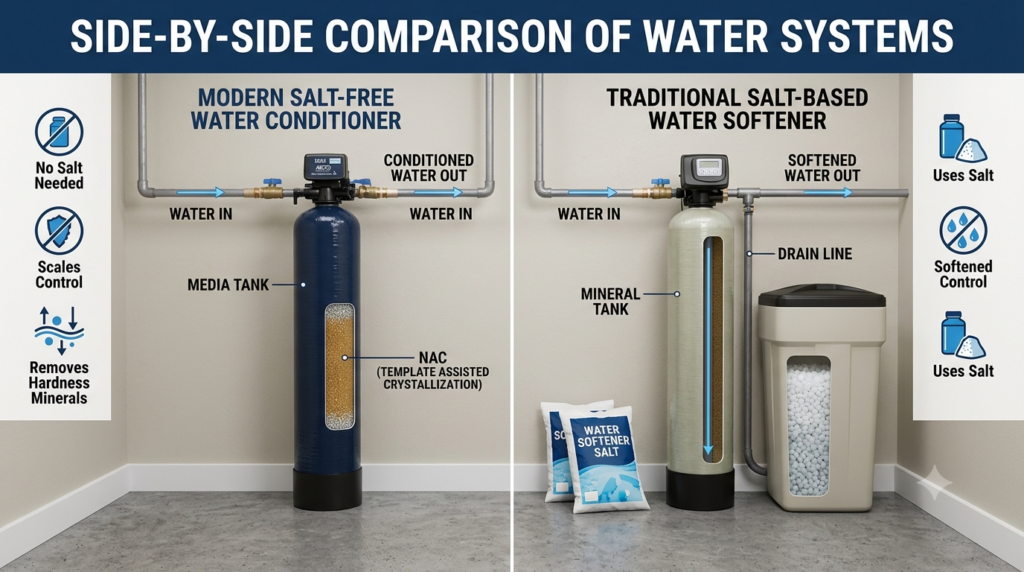
Salt-based water softeners don’t simply add table salt to your water. The ion exchange process used in many water softening systems is a widely studied water treatment method that exchanges hardness minerals such as calcium and magnesium with sodium or potassium ions.
Instead, they use an ion exchange process that replaces hardness minerals, primarily calcium and magnesium, with sodium or potassium ions.
The salt itself is used to regenerate the system’s resin media rather than remaining in large amounts in your household water.
For many households, the resulting sodium increase is relatively small, though it can vary depending on your water hardness and system settings.
Salt-free systems work differently.
Rather than removing hardness minerals, they help reduce the effects those minerals have on plumbing and household fixtures through water conditioning technologies.
Depending on the system, they may also incorporate advanced filtration media to reduce contaminants such as:
Unlike traditional softeners, salt-free systems:
For homeowners focused on improving overall water quality without maintaining a salt tank, this can be an appealing solution.
Although they’re often compared, these systems are designed for different purposes.
The answer depends on your goals.
If your primary concern is hard water minerals, a salt-based softener remains one of the most effective technologies for reducing calcium and magnesium.
If your priority is improving overall water quality while minimizing maintenance and avoiding salt handling, a salt-free water filtration or conditioning system may be a better fit.
Some homeowners even choose a combination approach depending on their local water conditions.
If you’re still comparing technologies, read our guide on Water Softener vs. Water Filter vs. Combo System to understand when each solution makes the most sense.
California homeowners face unique water challenges. Homeowners can review local drinking water information, treatment methods, and annual water quality reports through the California State Water Resources Control Board’s drinking water program.
Many communities receive municipally treated water containing chlorine or chloramine, while hard water is also common throughout much of the state, including Riverside County.
At the same time, many homeowners are looking for solutions that:
Local regulations regarding water conservation and wastewater management have also encouraged many homeowners to explore alternatives to traditional softeners where appropriate.
The California State Water Resources Control Board provides information about drinking water quality and local water systems throughout the state.
This depends on the system.
A basic salt-free conditioner focuses on conditioning water rather than filtration like salt-free water filtration.
However, many premium whole-house systems combine salt-free conditioning with advanced Salt-Free Water Filtration media such as catalytic carbon, allowing them to improve water quality while also addressing contaminants like chlorine and chloramine.
To learn more about why catalytic carbon matters, read our guide on What Is Catalytic Carbon, and Why It Matters for California Water.
Salt-Free Water Filtration systems may be a good choice for homeowners who:
These systems are often selected by homeowners who value convenience and comprehensive water filtration throughout the home.
Learn more about our Whole House Systems designed for modern residential water conditions.
Salt-based softeners remain an excellent option for homes experiencing severe hard water. The Water Quality Association provides consumer education resources explaining how different residential water treatment technologies address specific water quality concerns.
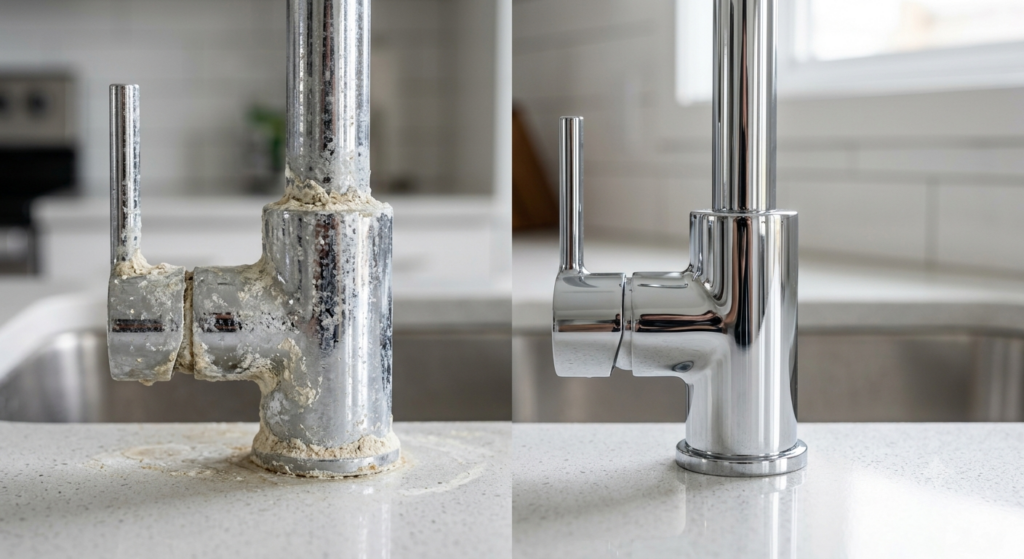
They may be appropriate if you regularly notice:
The best solution ultimately depends on your household’s water quality and treatment priorities.

No. Salt-Free Water Filtration systems condition water but generally do not remove the hardness minerals responsible for hard water.
Most homeowners do not notice a salty taste. The amount of sodium added depends on the hardness of the incoming water and the system’s configuration.
Some can; but only if they include filtration media such as catalytic carbon or activated carbon. Water conditioning alone does not remove chlorine.
There isn’t a one-size-fits-all answer. Homes with significant hard water may benefit from a traditional softener, while many homeowners looking for comprehensive water quality improvement and lower maintenance prefer salt-free water filtration systems.
Salt-Free Water Filtration systems and salt-based water softeners are designed to solve different water quality challenges.
Salt-based systems are highly effective at reducing hardness minerals, while salt-free water filtration systems focus on improving overall water quality with less maintenance and, in many cases, advanced filtration.
For California homeowners, understanding the difference between these technologies makes it easier to choose a solution that matches local water conditions, household priorities, and long-term maintenance preferences.
Whether your goal is better-tasting water, cleaner plumbing, or reducing the effects of hard water, selecting the right system starts with understanding what each technology is designed to do.