From Evince
Published 2026-08-13
Choosing a water filtration system Southern California homeowners can rely on starts with understanding what is actually in the water entering the home. Southern California water can present a combination of hardness minerals, disinfectants, taste and odor concerns, and other water-quality characteristics that affect plumbing, fixtures, appliances, and everyday comfort.
The right solution is not necessarily the largest system or the system with the most filtration stages. The better approach is to identify the primary water problem, determine how much water your household uses, and then select equipment designed to address those specific conditions.
For homeowners and plumbing professionals evaluating a water filtration system Southern California properties can use for years, the decision generally comes down to three questions:
The answers can point you toward a water softener, catalytic carbon filtration, or a combination system.
Before choosing a water filtration system Southern California homeowners should consider testing the water or reviewing the local water quality report.
The Centers for Disease Control and Prevention recommends testing water and choosing treatment equipment based on the specific chemicals or microorganisms you are concerned about. Different treatment technologies remove different substances, so there is no universal filter that solves every water-quality problem.
Credits: CDC.GOV
For public-water customers, your annual water quality report can provide useful information about the source and treatment of your water. You can also have water professionally tested when you need more specific information about hardness, metals, contaminants, or other characteristics.
This is especially important when evaluating a water filtration system Southern California homeowners may expect to protect the entire plumbing system. A system designed primarily for taste and odor is not the same as a system designed to reduce hardness minerals.
Hard water primarily contains elevated concentrations of calcium and magnesium. These minerals can contribute to scale formation on fixtures, showerheads, faucets, and water-using appliances.
The EPA identifies total dissolved solids, chloride, sulfate, iron, manganese, and other substances as potential contributors to aesthetic water-quality concerns such as taste, staining, deposits, or discoloration.
If your main concern is scale, soap performance, or mineral buildup, filtration alone may not be the answer.
That distinction is critical when selecting a water filtration system Southern California homes can depend on.
If your water test indicates significant hardness and your primary objective is reducing calcium and magnesium, a water softener is generally the appropriate treatment category.
A conventional salt-based softener uses ion exchange to reduce hardness minerals. The CDC specifically identifies water softeners as systems that remove primarily calcium and magnesium from hard water.
For homeowners, the benefits can include:
When selecting a water filtration system Southern California homeowners are considering for hard water, pay attention to capacity, flow rate, regeneration controls, connection size, and serviceability—not just the advertised grain rating.
For contractors, these specifications are equally important. A system must provide adequate flow for the home’s peak demand without creating an unnecessary pressure restriction.
A home with one bathroom has different demands than a large residence with multiple showers, appliances, and simultaneous fixtures.
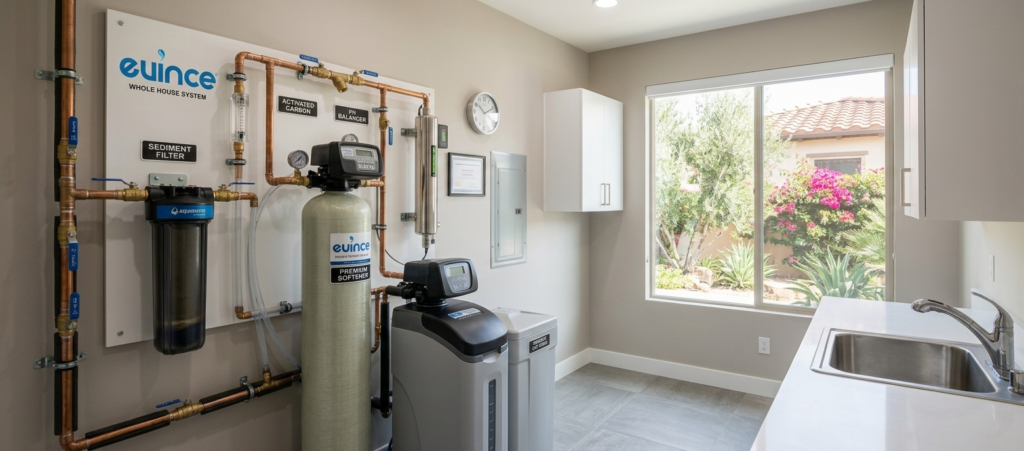
Evince whole-house systems are designed around residential water distribution, with several models providing approximately 10–15 GPM average flow and peak flow up to 20 GPM.
That makes flow capacity an important part of evaluating a water filtration system Southern California installation.
A system that treats water effectively but cannot comfortably support the home’s demand may not provide the installation experience homeowners expect from a premium system.
Hardness and disinfectants are different problems.
Municipal water systems use disinfectants to help control microorganisms as water travels through distribution systems. Depending on the utility and water source, chlorine or chloramine may be used.
If your primary complaint involves chlorine taste, odor, or concerns about disinfectant residuals, a catalytic carbon-based whole-house filter may be more appropriate than a softener.
A water filtration system Southern California homeowners choose for taste and odor should therefore be evaluated according to its actual media, capacity, flow performance, and certified claims.
Catalytic carbon is particularly useful because it is designed for applications where conventional activated carbon may not provide the desired performance against certain disinfectants.
Not all carbon media are identical.
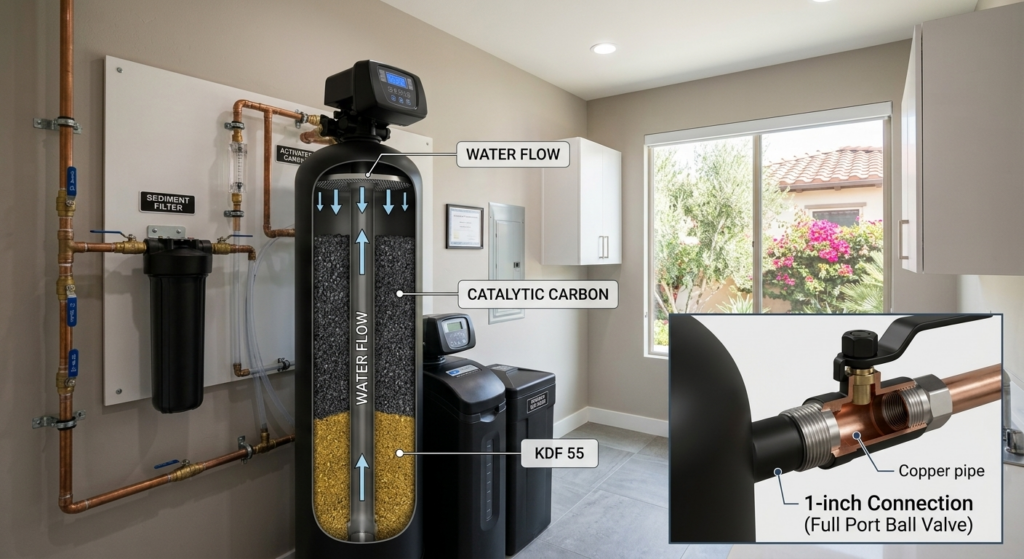
Evince Insight, for example, uses 1.5 cubic feet of 100% catalytic carbon together with integrated KDF 55 media. The system is designed to reduce chlorine, chloramines, heavy metals, and chlorinated gases while supporting whole-home flow.
The important lesson is broader than any one product: when comparing a water filtration system Southern California homeowners are considering, look beyond the word “carbon.”
Ask:
Those questions help separate a professionally engineered system from a generic filter housing.
Southern California homes do not always have one water-quality concern.
You may have hard water that contributes to scale while also wanting to reduce chlorine or chloramine. In that situation, installing only a softener may leave taste and odor concerns unresolved. Installing only a carbon filter may leave hardness minerals untouched.
That is where a combination water filtration system Southern California homeowners can use becomes valuable.
Evince offers both dual-tank and integrated single-tank approaches.
The Evince ELITE uses separate filtration and softening tanks.
Its filtration stage incorporates catalytic carbon and KDF 55 media, while the softening stage uses premium 10% cross-link resin.
The advantage of a dual-tank configuration is specialization. Each tank can be optimized around its treatment function.
For larger homes, luxury residences, and installations where maximum treatment separation is desirable, this can be an attractive configuration.
The Evince ELEVATE combines catalytic carbon, KDF 55, and cross-link resin in a single-tank configuration.
This approach can be useful where equipment footprint matters but the homeowner still wants both filtration and softening.
For a contractor evaluating a water filtration system Southern California project, single-tank equipment can simplify space planning while still providing multi-media treatment.
Another common mistake is assuming a whole-house filter and reverse osmosis system perform the same job.
They do not.
A whole-house system treats water entering the home, allowing treated water to reach showers, bathrooms, appliances, and faucets.
Reverse osmosis is commonly used as a point-of-use technology, such as under a kitchen sink, where the objective is highly purified drinking and cooking water.
The CDC explains that point-of-use systems generally treat water for an individual fixture, while whole-home or point-of-entry systems treat most or all water entering the home.
That means many homeowners do not have to choose between the two.
A practical setup may use a whole-house water filtration system Southern California homes need for general water quality and plumbing protection, paired with reverse osmosis for drinking water.
For more detail, see our guide on whole-house water filters vs. reverse osmosis.
The most important point is that a water filtration system Southern California homeowners choose should be matched to a measurable water-quality need.
For plumbers and contractors, system selection involves more than treatment performance.
Installation quality, service access, connection size, regeneration controls, bypass functionality, warranty coverage, and replacement-media availability all matter.
A professional-grade water filtration system Southern California contractors install should also be straightforward to service.
Evince systems include features such as manual bypass valves on applicable whole-house models, corrosion-resistant valve designs, programmable regeneration controls, and 1-inch connections.
For contractors, these details can make the difference between a system that looks good on paper and one that works well throughout its service life.
Certification and testing should also be part of the buying decision.
Evince whole-house products include models certified or tested by IAPMO R&T against applicable NSF/ANSI and CSA standards. Homeowners should always verify the exact certification and performance claims for the specific model they are purchasing.
The CDC also recommends looking for relevant NSF certification and checking what a specific filter is certified to reduce rather than assuming that every product with a particular technology removes the same contaminants.
Even the best water filtration system Southern California homeowners install needs appropriate maintenance.
Carbon media eventually reaches its useful capacity. Softening resin requires regeneration. Valves and control components need periodic inspection. Drinking-water systems require filter and membrane replacement.
The CDC emphasizes that water treatment systems need regular maintenance and filter replacement according to manufacturer recommendations.
A system that is neglected may not deliver the performance expected from a properly maintained installation.
That is why long-term serviceability should be considered before purchasing.
Before choosing your system, work through this checklist:
This process makes selecting a water filtration system Southern California homeowners can confidently install much easier.
The best water filtration system Southern California homeowners choose is not necessarily the most complicated system. It is the system that matches the water conditions, household demand, installation environment, and long-term maintenance requirements.
If hardness is the primary issue, start with a properly sized softener.
If chlorine or chloramine is the main concern, consider catalytic carbon filtration.
If you have both hardness and filtration concerns, a combination system such as a dual-tank or multi-media configuration may provide a more complete solution.
And if your priority is highly purified drinking water, consider pairing whole-house treatment with a point-of-use reverse osmosis system.
For homeowners and contractors who want to explore professionally engineered options, Evince Whole House Systems offers whole-home softening, filtration, and combination solutions designed around real-world residential water conditions.
Ready to discuss a project, wholesale pricing, technical specifications, or dealer opportunities? Contact Evince Water Group to connect with the team.
The best system depends on the water-quality problem you are trying to solve. For hardness and scale, a water softener is generally appropriate. For chlorine or chloramine concerns, catalytic carbon filtration may be more suitable. If both issues are present, a combination system can address both treatment needs.
A conventional carbon filtration system is not designed primarily to remove calcium and magnesium hardness minerals. If scale and hard-water buildup are the main concern, a properly sized water softener is typically the more appropriate technology.
They serve different purposes. A whole-house system treats water entering the residence, while reverse osmosis is generally installed at a specific point of use, such as the kitchen sink. Some homes benefit from using both.
Start by reviewing your water quality information and identifying whether chlorine or chloramine is present. If taste, odor, or disinfectant reduction is a priority, a catalytic carbon system may be worth considering. Always verify the specific system’s performance claims and certifications.
Service life varies according to water conditions, usage, media, maintenance, and equipment design. Rather than relying on a single universal lifespan, review the manufacturer’s warranty, media specifications, expected service intervals, and maintenance requirements before purchasing.